

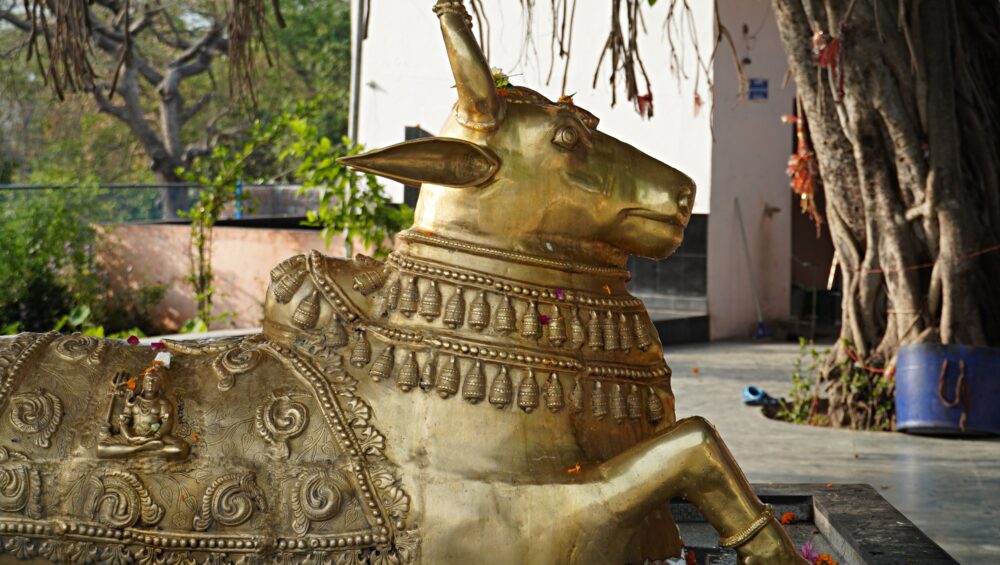
Who is Nandi, the sacred bull and vahana of Shiva? His story, symbolism, why he faces the shrine, and how a Nandi statue is placed in the home.
Nandi — The Sacred Bull of Shiva
Who Is Nandi?
Nandi is Shiva’s bull and also the vahana, or the vehicle, of Shiva and the silent protector watching over his abode. In addition, he has also been referred to as Nandikeshvara or Nandideva, and in certain legends, he is even considered the protector of Kailash, the mountain where Lord Shiva lives. Step inside any temple dedicated to Shiva, and the first thing you will see is Nandi seated outside the temple door with eyes fixed upon the sanctum. This is not merely an embellishment but a tradition wherein Nandi guards the entrance. It is quite significant that the worship of Nandi has over the years led to the reverence for bulls in Hinduism.
Origin, Story & Symbolism
Three different people consulted for three different answers to the question regarding the origin of Nandi — and, within the framework of the Puranic tradition, this is all good. These stories are not viewed as contradicting each other but rather different perspectives on the same truth. The most common story, found in the Shiva Purana, features the sage Shilada, who underwent the ritual of penance for a thousand years just to ask for a son; he was granted one blessed with immortality. This child was Nandi. Other scriptures have their versions: according to the Mahabharata, Nandi came into being in the form of a bull, gifted to Shiva by the creator god Daksha Prajapati, who Shiva chose to become his vahana. Even more elaborately, the Skandapurana describes Nandi as an incarnation of Dharma, another god.
The symbolism represented by Nandi does not change regardless of which version is used. This is devotion personified — unwavering, consistent, and faithful — as well as raw power and virility, as Shiva’s protector of all the four-legged creatures on Earth. The task assigned to him is not limited to his service as a temple animal, for he also guides the ganas that attend Shiva
Why Nandi Faces the Shrine
However, in case of the Shiva temples, Nandi is depicted in the posture of sitting and staring straight into the sanctum. The arrangement was purposefully done, not just out of tradition for the sake of tradition. The symbolism behind the seating Nandi staring into the sanctum is that of the individual soul, signifying that it must always look upon Shiva. From the yogic perspective, Nandi is the mind that focuses itself on the absolute or is the inner guru. It was this positioning of Nandi which resulted in a practice that continues to date, that is, the practice of whispering one’s desires into his ear.
Famous Nandi Statues in India
There are some Nandi sculptures which serve as individual monuments too. The sculpture of the monolithic Nandi carved out of a granite rock during the 17th century by Maharaja Dodda Devaraja Wodeyar on Chamundi Hills in Mysore is 15 feet tall and 24 feet long – one of the biggest of such sculptures in India. In Lepakshi, the biggest Nandi sculpture in the world measuring 6 metres tall and 10 metres long can be seen. The Bull Temple at Bengaluru built by Kempegowda in the Dravidian style during the 16th century has a massive Nandi sculpture in stone covered with flower garlands.
Our Handcrafted Nandi
The Nandi Bull Statue in Brass of ours is cast and finished in the traditional lost wax process in Jaipur by artisans. Available at ₹25,500, it is designed as an individual devotion piece that would be suitable for use in a personal shrine, on a console or anywhere where it can be placed to face a Shiva idol. Please check out more on the product page, the sculptures page or the craftsmanship page.
FAQs
Who is Nandi in Hinduism?
Nandi is the sacred bull and vahana (mount) of Shiva, and the guardian of his abode — usually shown seated at the entrance of Shiva temples.
Why does Nandi face Shiva?
He’s positioned facing the sanctum as a gatekeeper and as a symbol of the devotee’s focus — the soul turned toward the divine.
Can I keep a Nandi statue at home?
Yes, a Nandi statue can be kept at home as a symbol of devotion, strength, and positivity.


